BREAKING NEWS

Like this page? Share it with your friends!

Showing posts with label story. Show all posts

Saturday, May 6, 2017

Elderly Dog, Dropped off at Shelter in a Garbage Bag, Learns to Love Again

Last week, Blackie's family wrapped their bleeding dog in a garbage bag, placed the bagged pet in a cardboard box, and brought her to a busy Southern California animal shelter.

Kelly Smíšek is founder of Frosted Faces Foundation, a nonprofit founded in 2014 that specializes in helping old dogs — the group rescues some 100 canines per year.

After learning that Blackie was in the shelter — in pain and in need of help — there was no way Smíšek was going to let her stay there.
Blackie was dropped off at a busy California shelter wrapped in a garbage bag. | Courtesy of Frosted Faces Foundation

"We rescue the senior animals whose love and lives are left behind and in jeopardy," she told TODAY in an email.

Blackie is about 10 years old, and a small girl — about the size of a corgi — with a white-streaked face that looks happy, despite what she's been through.

Even outside of the bleeding tumor, and the manner in which she was brought to the shelter, there are indications that during her first decade, Blackie hadn't been looked after so well.

Dr. Beth Gordon is a veterinarian at High Valley Veterinary Hospital, in Ramona, California, who examined Blackie after her rescue. Gordon said Blackie has a heart murmur, some scars on her body, one wonky eye and teeth that have been neglected.
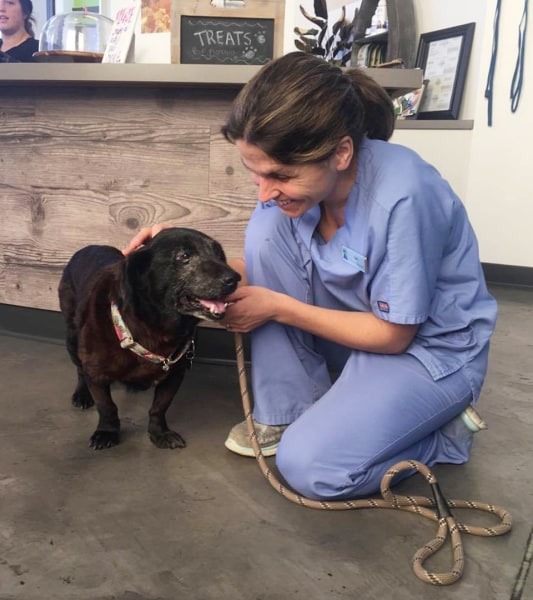
ackie, before her surgery, with veterinary technician Deborah Whitman | Courtesy of Frosted Faces Foundation
Then, of course, there is the tumor, which was big, infected and "very painful" for Blackie, Gordon said. "Someone didn't take very good care of her at all."

That's changed now. Blackie is at Frosted Faces Foundation headquarters, near San Diego.

She is being tended to — and with a lot of love.
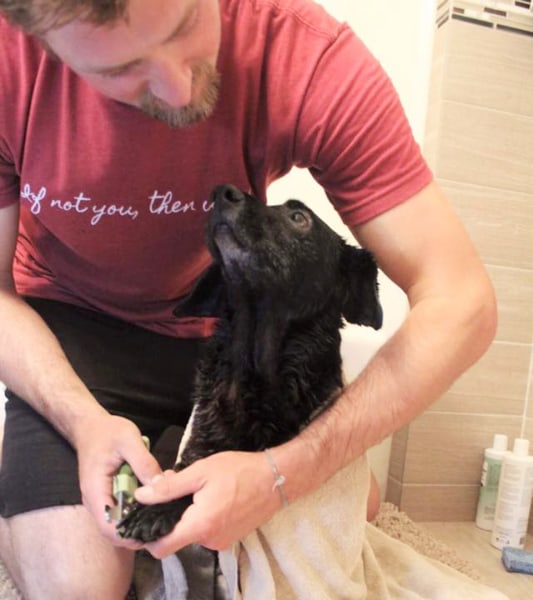
Blackie enjoys her spa treatment. | Courtesy of Frosted Faces Foundation
Blackie has quickly learned the pleasures of being clean, and of wearing a fresh new collar, eating plenty of good food and resting on soft beds.

Her teeth have been brushed, her nails trimmed and she rolls right over for belly rubs "if you give any indication of wanting to pet her," said Smíšek .
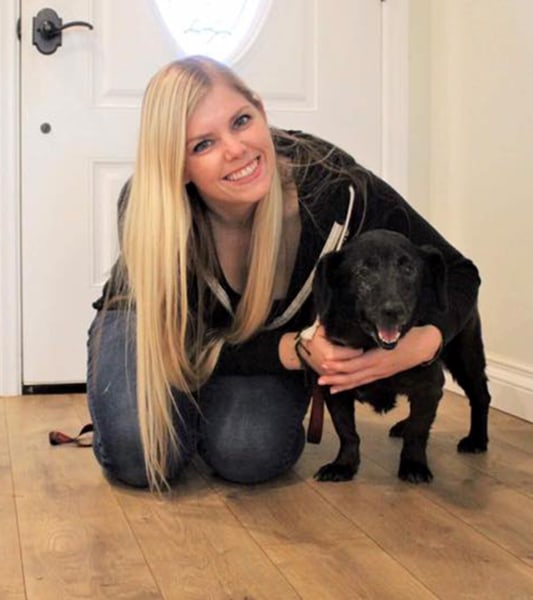
Blackie with Frosted Fraces Foundation volunteer Kelly Anne Honrath. | Courtesy of Frosted Faces Foundation
Blackie's had surgery to remove her tumor. And to be safe and make sure no cancer cells were left, most of her tail was also removed.

Biopsies showed that Blackie had been suffering from the sort of cancer that often spreads into a dog's lymph nodes and lungs.

"But diagnostics have proven that it had not yet," said Smíšek. "She has recovered well, the swelling has gone down and she is running around happily."
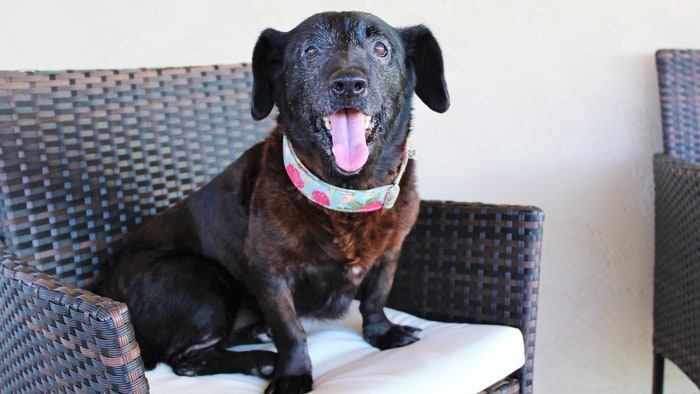
Blackie is all smiles now. | Courtesy of Frosted Faces Foundation
Soon, Blackie will be running around happily in a home.

Frosted Faces Foundation is sorting through the applications that have been placed by people who want to make sure that Blackie's next act is better than what came before.

Once her stitches come out, and she is medically cleared, Blackie will go to what's called a "forever foster" home. Frosted Faces covers these dogs' medical bills. The foster homes promise to love and care for the dogs for as much time as they've got left.

It's impossible to say how long that could be. Gordon believes Blackie could have another three or four years of life ahead.

SOURCE: Today

Sweet, Sweet Syria: Refugee Mom Finds Support, Success in Cookie-Baking Business

It's a sweet success story: a refugee family finds a safe place and a supportive community in the U.S. and a Syrian woman uses a family recipe to start her own business in a new country.

Ruwaida G, who asked that her last name and face be withheld due to concerns for the safety of family members who remain in Syria, fled the country in 2012 with her husband, Khaled, and her two children, daughter, Zainab, 12, and son, Mohamad, 9.
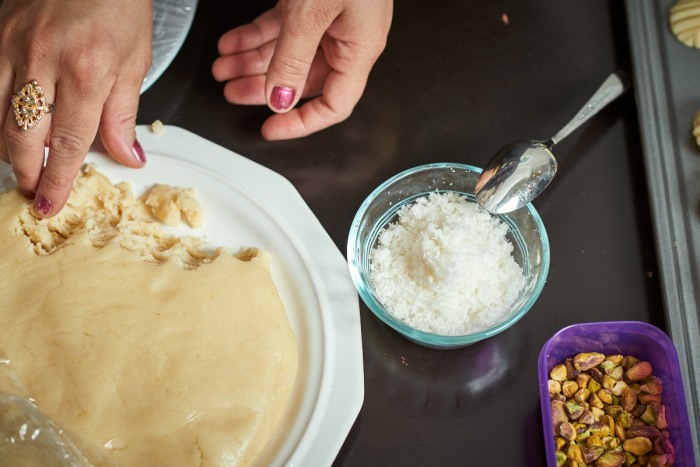
Ruwaida's cookies are hand-molded using a wooden mold she received from her own mother. | Amanda Avutu

After applying for asylum in Jordan, the family arrived in the U.S. in 2016, settling in Georgia with the assistance of New American Pathways, an organization that helps refugees get settled in the Atlanta area, and Holy Trinity Parish, a church that co-sponsored the family.

"We decided to leave Syria because we feared for our lives and for our children's lives," Ruwaida told TODAY Parents with the help of an Arabic-speaking translator. In Syria, Khaled was a small business owner with a few electronics stores. Ruwaida was a homemaker. "There was no safety in Syria wherever we went, and we needed to leave if we wanted to survive," Ruwaida said.

Brian Bollinger is executive director of Friends of Refugees and says Ruwadia and her family have official refugee status in the U.S., describing their situation as "a type of indefinite residency" that allows them to work, apply for a social security card and state identification card or driver's license, and, after a full year, apply for a green card for permanent residency.

"Refugees come to the United States at the specific invitation of the U.S. government, after passing the most rigorous vetting processes in existence for immigrants," explained Bollinger.

One of the limited items Ruwaida carried with her on her journey was a wooden mold that her mother used to teach her to make traditional, Syrian cookies. Ruwaida had no idea as she packed the family heirlooms that the cookie mold would hold the key to her earning a living in the U.S.

Amanda Avutu met Ruwaida and her family shortly after their arrival in Georgia, after seeing a Facebook post soliciting volunteers to help set up the family's new apartment.

"As I started visiting with the family and getting to know them more," said Avutu. "we would go to their house and they would make us coffee and she started serving us cookies. We were going there focused on helping her husband find a job, but then found that she was literally serving us up an opportunity."
Upon making new friends in the U.S., Ruwaida served them her cookies, leading them to encourage her to start her own business. | Amanda Avutu
Ruwadia's cookies are hand-molded, and made with a 10-step process.

"They're amazing," said Avutu. "We joke about how a human needs eight loving touches a day to feel loved, and each one of Ruwaida's cookies gets 10."

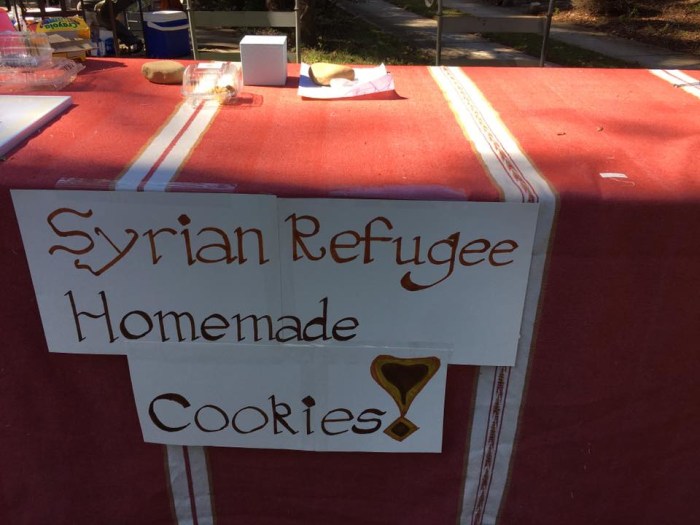
Avutu says she and her friends approached Ruwaida about selling her cookies for profit. Although the mom-of-two was surprised by the suggestion, she was willing to give it a try, and baked 45 dozen cookies to sell at a table at a local music festival.
At the urging of her friends, Ruwaida baked 45 dozen cookies to sell at a local music festival. Her cookies sold out before the first band played. | Amanda Avutu
"She sold out before the first band played," said Avutu.


Soon after, Ruwaida and her husband, with the help of five friends who call themselves "the advisers," created Sweet, Sweet Syria — a cookie business that Ruwaida hopes will grow into a successful family endeavor.

"I learned how to make these traditional, Syrian cookies from my mother, who learned it from her mother, and so on," said Ruwaida. "It is a family recipe. I learned how to make them when I was 14 years old when my mother taught me to perfect them, and I have been making them ever since."

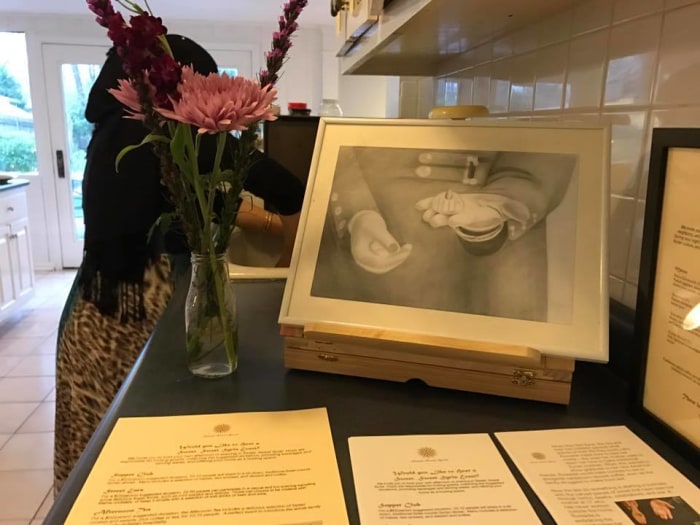
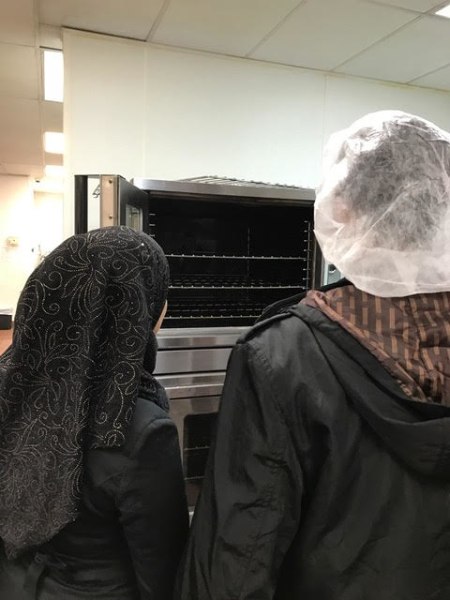
Avutu, who serves as one of Ruwaida's advisers, says she served as co-applicant with the family to a business accelerator course, moving through a 14-week program with Ruwaida that taught the woman about business ownership. Ruwaida then signed a lease on a commercial kitchen space, where she will soon begin making cookies to be sold at local coffee shops, restaurants and specialty grocery stores. Sweet, Sweet Syria will soon also expand to accept online orders.
Ruwaida says she enjoys seeing people eat her cookies and experience her family's special recipe. | Amanda Avutu
Avutu says Ruwaida's husband, Khaled, who works as an assistant chef, is her fiercest supporter.

"They are very much partners in this business," said Avutu. "She was a homemaker previously...and he's been immensely supportive of her having this opportunity to work. Previously, they hadn't really thought about that."

Avutu describes the emotion and pride she witnessed when accompanying the couple to sign the lease for their commercial kitchen.
Friends of the couple say Ruwaida's husband, Khaled, is her fiercest supporter. | Amanda Avutu
"Only one of them could sign the papers, and Khaled said, 'You sign it, of course,'" Avutu recalled. "You could tell she was thinking, 'Why me? I'm just a woman.' And he said, 'Just a woman? You're stronger than three men...and you're in America now.'"

Ruwaida says her husband shares her vision for Sweet, Sweet Syria, and hopes to see the cookie business expand into a restaurant that features traditional, Syrian food.

"He believes our success will help our children succeed in their life," said Ruwaida, adding that her daughter hopes to become a pediatrician and her son has aspirations of serving in the U.S. Army and pursuing a career in law enforcement.

"On the day signing the papers, Khaled said signing the papers is our first step to success." Ruwaida recalled. "He encouraged me saying, 'You're doing a good job. You are making the whole family succeed.' He encouraged me and said that I am a strong woman and that is a great thing for our family."
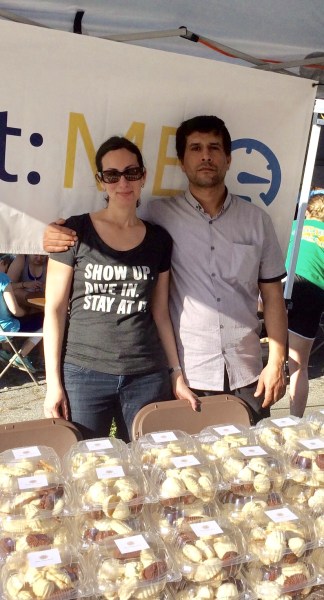
Amanda Avutu with Khaled G.
To ensure Ruwaida's success, her advisers have started a GoFundMe to raise money to cover her first year of rent in the commercial kitchen, and to eventually help the couple achieve their dream of opening their own brick and mortar store, where people new to the U.S. and long-time U.S. citizens can gather to share their commonalities.

As the granddaughter of Holocaust survivors, Avutu says the refugee crisis is close to her heart.

"I couldn't imagine not doing anything and everything in my power to make sure that they're not only surviving, but thriving here," said Avutu.

To date, the GoFundMe has raised more than $18,000 of the $30,000 goal.

Bobby Whithorne is the director of strategic communications for GoFundMe, and says the platform has seen more and more campaigns in recent months started by people who want to help refugee families in need.

"It's touching to see the kindness and generosity of everyday people who want to make things better for these families, and we hope others are inspired to help refugees around the world," said Whithorne.
uwaida's cookies take a 10-step process to complete.
Ruwaida says she feels happy every time someone takes a bite of her cookies and enjoys her family recipe that has been handed down for generations.

"I am lucky to have a group of dear friends...I couldn't have made it without them," said Ruwaida. "I hope that people who read (my story) see that we had a life before, and because of war we were forced to leave and rebuild our lives in a new country."

"I want them to know that we are thankful for the generosity of people and their willingness to see us and treat us as fellow human beings."

SOURCE:  Today

Wednesday, May 3, 2017

My Husband and I Got Married in the Church My Grandpa Built

The tale of how my grandparents became a couple is family legend. Their dads worked together in central Wisconsin. When Bill ignored Judy at a country dance, she went over and kicked him for being rude. Three months later, they were engaged. On Oct. 29 of that year, they were married.
LAURA SCHMITT PHOTOGRAPHY/ COUNTRY EXTRA MAGAZINE

Together they’ve traveled to all 50 states, created a family and started a successful business. Those who know and love them think Grandpa Bill and Grandma Judy were made for each other. Their marriage is an example for us all.

When my future husband, Brett, proposed and I accepted, we picked my grandparents’ 56th anniversary as our wedding date and held our ceremony in the little church on Grandpa and Grandma’s property.

In a former life, the beautiful country church was an old garage slated for demolition. Grandpa, a carpenter almost all his life, saw that it had good bones and rescued it. Then he turned it into a place of worship. With 10 wooden pews, a small bell tower and an antique pump organ, the church is a tribute to a God that has blessed our family in so many ways.

The church is one of several structures on the property. As he neared retirement, Grandpa built a village to recreate his childhood haunts on his land. The one-room schoolhouse is a scale model of the school he attended through eighth grade. There’s a log cabin originally built in 1847. (Get a laugh from these funny church signs.)
My-Husband-And-I-Took-Our-Vows-In-The-Church-My-Grandpa-Built
BREANNA BUTLER/ COUNTRY EXTRA MAGAZINE
An assortment of treasures are scattered all over the property: a gas station, covered bridge, tavern, general store, train station, town hall, farm machinery building, outhouse, corncrib, pump car and a playground.

The buildings are filled with antiques that my grandparents, who are both passionate about preserving history, have collected through the decades. It’s like a museum. Sometimes Grandpa gives tours to school kids so they can see the way people used to live. He has an awesome sense of humor and his tours are so entertaining. Grandpa is one of the humblest people you’ll ever meet, but also one of the most talented.

As a child, I explored the old buildings, traveled up and down the tracks on the pump car, and played on the schoolhouse merry-go-round. However, the church was always my favorite.

So on my wedding day, Grandpa drove me to the village in his Ford Model T. Brett and I married in a traditional Lutheran ceremony. In the presence of our closest family and friends, we began our married life on a special day in a special place surrounded by an almost overwhelming amount of love.

My husband and I will strive to still be on our honeymoon 56 years from now, just like Grandma and Grandpa are.

SOURCE: RD

Sunday, April 30, 2017

New York Launches Its First Girl Scout Troop for Homeless Girls

Giselle Burgess knew moving into a homeless shelter with her five kids would be tough for her family. For security reasons, kids can’t hang out in each other’s rooms or in the hallway, so Burgess wanted more of a community feel.
MONKEY-BUSINESS-IMAGES

As Queens community development specialist for the Girl Scouts of Greater New York, Burgess already knew the benefits of joining a troop. She figured starting a Girl Scout troop in the 100-family Queens homeless shelter was the perfect solution. (Meet the woman who plans birthday parties for the homeless.)


Burgess called up Heidi Schmidt, director of government relations for the New York City Department of Homeless Services. Together, they formed a troop for the homeless shelter. The Girl Scouts of Greater New York covered the costs to make it affordable for the homeless girls. (Visit their page if you’d like to donate.)


Girl Scout troops from the other five New York boroughs are numbered in the 1000s, 2000s, 3000s, 4000s, and 5000s. The new troop picked 6,000 to represent the homeless girls. Other Girl Scout troops have formed in other states before, but this was the first one in New York. More than 62,000 people in the city are homeless, and about 40 percent of those are children.


Just eight girls, including Burgess’ three daughters, attended the first meeting, but they quickly spread the word. Now, Troop 6000 has 25 consistent members. The girls had seen each other around in the building before, but the meetings turned them into friends. “They are there to support each other and spread positivity,” says Burgess. “They see each other in the hallway and there’s just hugs.”


Troop members range from five years old to early teens, but the age gap doesn’t get in the way of their sisterly bond. The older members are protective of the younger scouts, helping them with activities. Not only are they spreading love, but they’re learning responsibility. “These girls are taking that leadership and owning it,” says Burgess.


The troop is already inspiring feminist leadership for the girls. Leaders from around the community, including the chief operating officer of Girl Scouts of Greater New York, district manager of a community board, Queens Borough representative, and a local councilmember attended the first meeting. “All the adults in the room were women except the councilmember,” says Schmidt. “Three girls asked separately, ‘Are you the boss of the Girl Scouts?’ to the man in the room.”

Since then, meetings with Troop 6000 have shown them women can be leaders, too. For instance, a visit the New York City Council showed Speaker Melissa Mark-Viverito as a woman in power.

MONKEY BUSINESS IMAGES/SHUTTERSTOCK, RAWPIXEL.COM/SHUTTERSTOCK
Even beyond their weekly activities learning about a theme like women’s suffrage, financial literacy, or first aid, the girls are stepping up as leaders. Every meeting, they rotate responsibilities such as handing out snacks, taking attendance, and cleaning up. “It builds in this level of respect because they all know they have to come around and take the role on,” says Schmidt.

And that responsibility lasts beyond the Girl Scout meetings. Burgess says she’s proud every time a girl talks about sticking up for a classmate, or when a mom says her daughter is suddenly stepping up more to help the family.


Plus, the troop is trying to get the rest of the community involved. Burgess and Schmidt hope to encourage women to take on leadership roles with the troop and to bridge the gap between the shelter and the rest of the neighborhood. “It would be so much easier for families living in the shelter and for the community to understand and not feel like it’s a burden upon them or be afraid of who’s in the shelter,” says Schmidt. “It’s good for families to know they’re embraced and welcomed by the community. The girls can go on to do great things and not be bound by their current situation.”


In fact, one woman has already volunteered to become the first leader for Troop 6000—and she doesn’t even have a daughter, says Burgess.


Troop 6000 hopes to inspire Girl Scout troops to pop up in more shelters around the city. The girls might be enjoying some press right now, but Burgess says they won’t be sad when coverage dies down. “They say, ‘That means our job is done and we passed it on,’” says Burgess.


SOURCE: RD

Friday, April 28, 2017

The Local Gravedigger Who Saves Lives on His Days Off

Johnny “Digger” Tucker has dug the graves of over 20,000 people.
Saturday night had just turned into Sunday morning, and Tim Abernathy, 47, walked off the dance floor at the Menlo Barn Dance near Summerville, Georgia. He sat down in a folding chair to rest with his wife, Tina Abernathy, next to him. Then something felt wrong. His throat got tight, then tighter. He grabbed Tina’s hand, then crashed to the floor.

“His eyes had rolled back,” said Tina. “His lips had turned blue and were getting darker.”

The band stopped playing. People started yelling, but nobody stepped forward to act. Someone finally did.

It was Johnny “Digger” Tucker. He swiped his fingers through Tim’s mouth, thinking he could be choking. He started beating on Tim’s chest. Then he began mouth-to-mouth. More pounding. More mouth-to-mouth. Then, finally, Tim drew a breath. The paramedics came, and Johnny quietly left.

“If Johnny hadn’t been there, I would be burying my husband,” said Tina.
Folks say Johnny Tucker is the type of man you’d call at 2 a.m. The type whose handshake is his word. Maybe it’s because he knows more than most how precious life is. Every day, he faces death.

Johnny is a gravedigger. Ever since he was a boy, he has been digging, just as his father did—not with a backhoe but by hand, with a shovel and a pick. He has dug the final resting places for about 20,000 people, each grave measuring three feet wide, eight feet long, four and a half feet deep, in hard, frozen ground or wet Georgia clay. He has his rules: no cussing, smoking, or radio playing during the grave­ digging. “I treat every­body as if it’s my family I’m burying,” he said. He is so respected around Chattanooga that funeral directors arrange their schedules around his availability.

So maybe it’s not surprising that Johnny often finds himself in a position to lend a hand. That night at the barn dance was actually his second death-defying feat. In the ’90s, a car driving in front of him veered off the highway, crashing into a flooded, freezing creek. Johnny jumped out and pulled the driver to safety. “I don’t want to see somebody leave this world,” Johnny says, “if I know I could have saved them.”

On top of that, Johnny has been fighting his own health battles for the past four years. “Non-small cell carcinoma,” Johnny says. Cancer. He has weathered two years of chemo­therapy. “He’s as tough as they come,” says his wife, Mary Tucker.

That’s why the couple spends Saturday nights at the barn dance, living it up and, frequently, closing the place down. Johnny and Mary were actually on their way out the door that night when Tim Abernathy collapsed. But then the band started playing that old Vern Gosdin song “Chiseled in Stone,” the one that goes, “You don’t know about lonely ’til it’s chiseled in stone.”

“Our song,” said Johnny to Mary.

They turned around for one more slow dance. Minutes later, the gravedigger had saved another life.

SOURCE: RD

This Powerful Story Will Convince You to Stop Saying “Let Me Know If You Need Anything”

Still in shock, I stumbled about the house trying to decide what to put into the suitcases. Earlier that evening, I’d received a call from my hometown in Missouri telling me that my brother, his wife, her sister, and both the sister’s children had been killed in a car crash. “Come as soon as you can,” begged my mother.
JOHAN-LARSON/SHUTTERSTOCK
That’s what I wanted to do—to leave at once, to hurry to my parents. But my husband, Larry, and I were in the midst of packing all our belongings to move from Ohio to New Mexico. Our house was in total confusion. Some of the clothes that Larry and I and our two young children, Eric and Meghan, would need were already taped up in cartons. Which ones? Stunned by grief, I couldn’t remember. Other clothes lay unwashed in a pile on the laundry-room floor. Supper dishes still sat on the kitchen ­table. Toys were strewn everywhere.

While Larry made plane reservations for the following morning, I wandered about the house, aimlessly picking things up and putting them down. I couldn’t focus. Again and again, the words I’d heard on the phone echoed through my head: “Bill is gone—Marilyn too. June—and both the children …”

The love in the act released my tears at last, healing rain to wash the fog from my mind.

It was as though the message had muffled my brain with cotton. Whenever Larry spoke, he sounded far away. As I moved through the house, I ran into doors and tripped over chairs.

Larry made arrangements for us to leave by seven o’clock the next morning. Then he phoned a few friends to tell them what had happened. Occasionally, someone asked to speak to me. “If there’s anything I can do, let me know,” that person would offer kindly.

“Thank you very much,” I’d reply. But I didn’t know what to ask for. I couldn’t concentrate.

I sat in a chair, staring into space, while Larry called Donna King, the woman with whom I taught a nursery class at church each Sunday. Donna and I were casual friends, but we didn’t see each other often. She and Emerson, her thin, quiet husband, were kept busy during the week by their own “nursery”—six children ranging in age from two to fifteen. I was glad Larry had thought to warn her that she’d have the nursery class alone the coming Sunday.

While I sat there, Meghan darted by, clutching a ball. Eric chased after her. They should be in bed, I thought. I followed them into the living room. My legs dragged. My hands felt gloved with lead. I sank down on the couch in a stupor.

When the doorbell rang, I rose slowly and crept across the room. I opened the door to see Emerson King standing on the porch.

“I’ve come to clean your shoes,” he said.
Confused, I asked him to repeat.

SOURCE: RD

An Annual Ski Trip Turned Into a Quest for Survival

Liisa and Tuomo Peltola step from their bungalow in a forested suburb of Turku, a small city in southwest Finland. It is just before 8 a.m. on a sunny Saturday morning at the end of March in 2015, nippy but with the promise of warmer weather to come. They are about to embark on a 1,200-kilometer two-day car trip to the fells of Lapland above the Arctic Circle for their annual four-day ski trip.
Image: READER'S DIGEST INTERNATIONAL EDITION
The couple check their backpacks: sleeping bags, instant coffee and two water-resistant covers they’ll use at night in the rustic wilderness huts they plan to shelter in. They’ll stop en route for a night and buy food. After attaching their backcountry skis atop their hatchback, they settle down for the two-day drive to just beyond Kilpisja¨rvi, a settlement of Sami, an indigenous people also known as Laplanders. There, they’ll begin their trek.

It’s easy driving, and on occasion, Liisa points out a bird that Tuomo must squint to see, for he has taught her to love birdwatching as much as he does.

“You can see so much farther than me,” he grumbles good-naturedly.

“Yes,” she says happily. “I can.”

There has always been a bit of competition between them, from birdwatching to running and skiing. Both are passionate about orienteering, a sport that requires them to find their way in unfamiliar terrain with a map and compass, and the wilderness is their playing field.

The ski trip in Lapland is one of their favorites, a straightforward trajectory they have done at least five times before: 30 kilometers due east across a fell, a high, mostly barren landscape, with rolling hills, some steep climbs and jagged boulders and rocks. Here, they can be alone in nature, with only the huts—a system of bare bone, sparsely spaced structures—their only contact with civilization.

Married for only four years, they met over half a century ago, when Liisa, now 65 was a shy, tall, talented teen with a thick blonde braid who a decade later would win the women’s world orienteering championship. Tuomo, nearly six years older, with craggy features and a dry sense of humor, was in the same orienteering club, already married, an engineer and maker of maps.

“Back then, I never imagined I would fall in love with you,” remarks Liisa. “I thought you were so technical and dull.”

“In some way, we stored our feelings,” he says.

There were other marriages along the way, and children to raise – Liisa’s three sons, and Tuomo’s son and daughter. On their first ‘date’ about 14 years ago, she thought it was just a walk in the forest. For Tuomo, it was more than that.

“I wanted to kiss you,” he says. And he did. Ten years later, they were married.

By Sunday morning, as they reach their starting point, the wind has picked up to a gale force 72 km an hour and is blowing snow that turns the world white with fat, black clouds overhead. But the weather doesn’t scare them. As orienteers, they’ve dealt with bad weather before.

SOURCE: RD

Wednesday, April 26, 2017

Pilot Turns Plane Around So Elderly Couple Can Say Goodbye to Their Dying Grandson

As an elderly couple was about to shut their phones off onboard a flight to Australia via Abu Dhabi, they noticed a missed call from their son-in-law. The plane was already starting to roll forward on the runway when they saw the text: Their grandson was in intensive care with a serious illness. If they didn’t get back soon, they might miss their chance to say goodbye.
AFRICA STUDIO/SHUTTERSTOCK, TOFE ALLEN/SHUTTERSTOCK

The couple got the attention of the Etihad Airways crew, who rushed to tell the pilot. Instead of shrugging off their pleas to stay on schedule, the kindhearted pilot turned the plane back around to the Manchester Airport gate.

From there, the rest of the staff jumped in to get them home as fast as possible. Some collected their bags and helped the couple through the airport, while others brought their car to arrivals so the grandparents could head straight home. The airline said they could use their tickets another time.

“I’ve been in the travel business for 25 years and never heard of this happening,” the couple’s travel agent, Becky Stephenson, told the BBC.

The boy passed away the next day, when his grandparents would have been in Australia, but they reached his bedside in time to say goodbye.

“They never in a million years expected the crew to go so far for them,” Stephenson told The Independent. “You shudder to think what would have happened if they hadn’t been able to get off the plane.”

SOURCE: RD

Sunday, April 23, 2017

Not Your Ordinary Pets: These Heroic Stories Prove Animals Are True Life-Savers

Did you ever imagine an animal could save your life? Meet some four-legged friends who’ve gone far beyond the call of duty to save their owners, lost kids, and even an entire continent.

Giant Rats Sniff out Danger
READER'S DIGEST INTERNATIONAL EDITION

Rats traditionally get a bad rap. We tend to think of them as disease-spreading vermin and like to give them a wide berth. But a crack team of skilled rats has already saved thousands of human lives in Tanzania, Angola and Mozambique—and Cambodia is next on the list.

Belgian organization APOPO is training giant African pouched rats to detect two of Africa’s cruelest menaces. The first is landmines. When civilians have to risk their lives just to fetch water or farm their land, they’re locked into poverty and development is impossible. Wanting to find a local, affordable solution, APOPO founder Bart Weetjens remembered the pet rodents he’d kept as a boy in Belgium. He knew rats were intelligent, sociable, and teachable. They were also in plentiful supply and relatively cheap to train.

APOPO’s heroic rats are also on the front line against Africa’s desperate TB crisis, where clinics are overwhelmed and diagnostic TB tests often inaccurate. (Globally, around 1.5 million people die from TB every year, and every untreated patient can infect up to a dozen other people.)

The rodents are socialized as pups and then trained so that the sound of a clicker means food, and they know that they need to search for the target scent to earn their reward. (Peanut and banana mash is the favorite.) They’re trained to sniff out either TNT explosives (contained in mesh tea-balls or in deactivated landmines) or TB (using sputum samples from patients suspected to be infected). Mine-detection rats complete their nine-month training on a field planted with both deactivated and live landmines.

Since 2007, the rats—which live up to eight years in captivity—have detected over 56,000 landmines and other explosives. The four-legged explosives experts are so light-footed, there hasn’t been a single casualty.

They’ve also screened almost 312,000 TB samples and detected over 8,000 cases that the public clinics missed. While it takes a lab technician all day to evaluate 20 samples, a rat can get it done in just ten minutes. Weetjens adds, “It’s so beautiful to see our rat trainers and their HeroRATs working jointly for a better world.”

Beloved Pet Dies Rescuing Family from Fire
READER'S DIGEST INTERNATIONAL EDITION

It seemed like any other day when fitness instructor Chantelle Lister set off to work at 7 a.m. It was the school holidays, so her daughters Loren and Mollie, 17 and six, and 11-year-old son Charlie were still asleep in bed.

But within an hour, the family home in Kettering, Northamptonshire, England, went up in flames. The fire started in the conservatory and lethal smoke from the uPVC windows started filling the ground floor while the youngsters slept.

Thankfully, the family’s beloved dog Bailey rushed to their rescue. Despite the thick smoke starting to engulf the staircase, the four-year-old Terrier-mix made his way upstairs and kept barking and scratching at Loren’s door until she woke up.

Loren opened the door to thick black smoke streaming up the stairs and the sound of smashing glass. Struggling to breathe, the teenager ran into her siblings’ room and managed to get the terrified children out through a bedroom window and onto a flat roof.

After successfully raising the alarm, Bailey scampered back downstairs to try to get out. Tragically, he was trapped in the burning house.

“The firemen pulled Bailey out and tried to resuscitate him, but he was dead,” Chantelle says. “They put a blanket over him and I kept thinking, ‘That could have been one of my children.’ Bailey was such a character and so loving. The children wouldn’t be here without him. He’s my hero and I’m eternally grateful to him.” (Read the emotional tales of other dogs who saved their owners.)

Dogs Team Up to Save Drowning Toddler


READER'S DIGEST INTERNATIONAL EDITION

They’re tough breeds and they have the rough-and-tumble names to match. But free-spirited Aussie dogs Tank the Rottweiler-cross and Muck the Staffie-cross instinctively knew when a small child was in danger, and their protective natures averted a tragedy.

One December afternoon, Georgie Hillier thought her two-year-old son Max was playing in the back garden of their home in rural Queensland, Australia. But when she went to check, there was no sign of Max or their dog Tank. When she couldn’t find them, she jumped in her car and started scouring the neighboring property. She was frightened her son could have fallen into one of the dams or reservoirs.

Then she found Tank with the neighbor’s dog Muck. They were both running around the dams, barking furiously and covered in mud and slime.

“I just panicked. I was running around, checking the sides of the dams,” Georgie told Sara Hicks from radio station ABC Local. While she kept searching, a neighbor called the police. Eventually, a woman who had found Max heard Georgie’s calls and brought the unharmed toddler out to her.

There was no one there to witness what exactly happened, but Michael Beattie from the Royal Society for the Prevention of Cruelty to Animals takes up the story. “When the police arrived on the scene, they saw quite distinct drag marks. It was apparent that young Max had actually been pulled out of the dam by one of the dogs—most likely Tank. Max was making moves to go back into the dam and Muck was virtually heading him off at the pass. It was the police’s opinion that the only way that Max was rescued from drowning was by the two dogs.”

For saving the toddler’s life, the daring duo received the RSPCA’s prestigious Purple Cross award for bravery—plus two very large bones.

Adopted Cat Moonlights as a Night Nurse
READER'S DIGEST INTERNATIONAL EDITION

Much as we love them, cats are not known for acts of altruism. So meet Pippa, an extremely unusual feline.

The black-and-white cat was dumped in a box outside a shop and rehomed by the British RSPCA to the Jansa family in Whitstable, Kent. They were charmed by her gregarious character—but never guessed she’d become a lifesaver.

Eight-year-old Mia Jansa had type one diabetes and had become a dab hand at testing her blood throughout the day, as well as having something to eat or drink to restore her blood-sugar levels. But the danger was at night. Mia was prone to having hypoglycemic episodes when asleep and, left untreated, a hypo can lead to a coma, medical complications and even death.

Soon after she was adopted, Pippa went into Mia’s bedroom in the middle of the night and woke her up. When the child tested her blood sugar levels, she found they were dangerously low. Ever since, Pippa regularly visits Mia at night. If she can’t get her to wake up, she raises the alarm.

“Pippa does this of her own accord,” says Pippa’s mother Laura. “We don’t reward her with food because we don’t want to encourage false alarms, but she gets plenty of cuddles instead. It gives me extra peace of mind to know someone else is keeping an eye on Mia.”
SOURCE: RD

Friday, April 21, 2017

This Couple Is Very Much in Love. That's Why They Sleep Separately.

Just because sharing a bed is considered the cultural norm, doesn't mean it's always the best option.

Melissa Bunker has been sleepwalking since she was a little kid.

It was harmless enough at first. She has silly stories, like the time in college when she walked around her dorm, took all the pictures off the wall, and then crammed them into the fridge.

After Melissa got married and began sharing a bed with her husband, Leon, the stories got stranger. One night, she woke up in the hospital and was told she had driven, in her sleep, from her home in North Carolina to the border of South Carolina.

Her sleepwalking, combined with Leon's snoring ("He sounds like a werewolf in heat," Melissa says), means there aren't many restful nights for the pair.
Image via iStock.
Eventually, Melissa's excessive sleepwalking, or somnambulism, was diagnosed as a symptom of sleep apnea, a serious disorder that occurs when a person's breathing is disrupted during sleep, often causing snoring.

After working with a sleep disorder specialist and getting CPAP treatment, Melissa is often able to spend a full night in bed.

But even with the diagnosis, Melissa and her husband don't share a bed every single night.

Melissa says she doesn't like the general judgment society seems to have about the practice of a couple sleeping in separate beds.

"It works for me and my husband," Melissa says. "What's more socially acceptable nowadays? Multiple partners in one bed or multiple beds with one partner?"

Perhaps the instinct to judge co-sleeping — and deciding not to — is a result of popular culture, suggests Lisa Medalie, a behavioral sleep medicine specialist at the University of Chicago.

"Interestingly, co-sleeping with a spouse was not always the norm," she says. "If you look back to television shows from the '60s, for example, shows like 'Dick Van Dyke' showed separate beds for the spouses in the bedroom. At this point in time, sitcoms largely show spouses sleeping in the same bed."
Image via CBS Photo Archive/Getty Images.
About 1 in 4 couples sleep separately, according to a survey from the National Sleep Foundation. And more recent surveys indicate that number could be climbing.

With so many couples sleeping apart, it's hard to understand why the phenomenon is associated with shame.

Part of it may be in the assumption there is no sexual intimacy, but Melissa says for Leon and her, that's not true at all. She wouldn't see Leon for long stretches of time while he was in an active duty military post. "Was I lonely? Yes. But did our intimacy wane? Absolutely not."

"Intimacy is going to be a case by case study," Melissa continues. "You can have someone who has a picturesque relationship — same bed or different country, they'll have that bond."

Just because sharing a bed is considered the norm, it's not necessarily better or more healthy.

"It would be great if people were more comfortable talking about things that troubled them so that others going through the same thing did not feel alone with their struggle," Medalie says.

We use beds to get a good night's sleep. You do not need to share a bed to have a loving and intimate relationship, but you do need a good night's sleep to be a high-functioning, happy partner.

"If a couple simply prefers to sleep separately, there is no need to feel wrong or bad about that preference," Medalie says, freeing us all from cultural judgment.

There you have it, doctor's orders.

SOURCE: Upworthy

The First Woman To Enter The Boston Marathon Finishes The Race Again, 50 Years Later

In 1967 a 20-year-old student at Syracuse University became the first woman to officially participate in the Boston Marathon.
Photo credit: Paul Connell / Getty Images
50 years later, Kathrine Switzer crossed the finish line of the Boston Marathon wearing the same bib number.

Switzer's marathon in 1967 became historic because she was the first woman to complete the all-male race as an official participant. She registered as "K.V. Switzer" to hide her gender.

A few miles into the race, an official tried to remove Switzer from the race and rip off her bib.

"Instinctively I jerked my head around quickly and looked square into the most vicious face I'd ever seen. A big man, a huge man, with bared teeth was set to pounce, and before I could react he grabbed my shoulder and flung me back, screaming, 'Get the hell out of my race and give me those numbers!'" she wrote in her memoir.

Switzer finished the race in four hours and 20 minutes, but would later be disqualified and expelled from the Amateur Athletic Union.

Plenty has changed in running since 1967, thanks to Switzer's efforts. Since 1972, women are welcome in the Boston Marathon and other major races.
Photo credit: Elise Amendola / Associated Press
On Monday, the 70-year-old finished the Boston Marathon only a little slower, in 4:44:31.

Her bib number was retired after the race — just the second number that the marathon has retired. Before her start, she was given the honor of firing the gun for the women's elite runners.

"In 1967, few would have believed that marathon running would someday attract millions of women, become a glamour event in the Olympics and on the streets of major cities, help transform views of women's physical ability and help redefine their economic roles in traditional cultures," Switzer wrote.

"We've come a light year but we still have a long way to go."


SOURCE: Sunnyskyz

Monday, April 17, 2017

Family Makes Dying Dog's Wish Come True

A Texas family made their beloved dog Charlie's last day one to remember.
Charlie's owner, Kevin, said he always believed she would be a great police dog. He even tried to train her from YouTube videos when she was young.

But this week, a veterinarian told the family that Charlie had a tumor in her brain. The family had to make the tough decision to put their dog down.

So on Charlie's final day, the Navid family took her out to get a burger and ice cream, they even let her wash it down with a rib-eye steak from a nearby restaurant. And when they saw a police officer at the park, they couldn't pass up an opportunity to take a picture.

"I don't think it was a coincidence he was there," Kevin told WFAA.
The officer posed for a photo with Charlie and the Denton Police Department shared it on Facebook, dubbing Charlie its newest K-9 officer, fulfilling a lifelong dream for the Navid family.

"When I saw those photos I just thought there is my Charlie. She's a K-9 officer all these years later," Kevin said.
SOURCE: Sunnyskyz.com

Brave Man Risks Jail Time To Save A Dying Baby Bear

When a man named Corey Hancock was hiking on the Santiam River Trail recently, he spotted a baby bear in desperate need of help. 
Credit: Corey Hancock/Facebook
Hancock, who is a photographer, recounts the incident on his Facebook page, where he explains that it began raining that day during his hike when he spotted the bear cub two feet off the trail. 

“Laying there on his back, seeming by all appearances to be dead,” wrote Hancock. “His lips were blue. His eyes were open but unmoving and hazy. The rain was pouring down, drenching his belly. I might have seen a shallow breath.”

Recalling passing by this same trail an hour before, Hancock knew the cub wasn’t there earlier, so he feared the bear’s mother might not be far away. Assuming he may be attacked at any moment, he took a quick photograph of the dying cub and retreated a short distance down-slope toward a cliff-edge overlooking the river. “I remembered hearing somewhere that bears don’t move as well going downhill. Any advantage I could get, I was taking,” Hancock wrote. 

From Hancock’s position by the cliff, he watched the cub and scanned the area for any sight or sound of other animals. Minutes passed, and he watched the tiny bear’s arm twitch a couple of times, indicating that he was alive. He knew he couldn’t survive much longer under these conditions, and he wasn’t going to stand there and watch the cub die in the rain. 
Credit: Corey Hancock/Facebook
So, putting his own life at risk, Hancock rushed to the cub and wrapped him up like a baby in his flannel shirt. “Finally, with this bundle of bear cub in one arm, I took off running toward the trailhead and my waiting vehicle,” he wrote. The whole time, he feared a raging mother bear would come after him, as black bears can smell humans from 500 yards away. Finally, Hancock reached his vehicle and he took the cub out of his stuff-sack and examined him on the passenger’s seat. 

He snapped a photo of the bear and uploaded it onto his Facebook, asking for help on where to take the dying baby bear. Hancock performed mouth-to-mouth resuscitation on him, and by this time, his Facebook post was getting attention.

“The next recommendation I got was to bring the cub to the Turtle Ridge Wildlife Center, where they had a worker who lived on-site. I phoned and, sure enough, Mary was prepared to greet us and admit the bear when we arrived. I gave him the name Elkhorn, which refers to the area where I found him,” Hancock wrote. 
Credit: Corey Hancock/Facebook
Mary could see immediately Elkhorn was near death. He was starving and dehydrated, so Mary put Elkhorn on a heating pad and injected him with electrolyte fluids. “The next morning, another Turtle Ridge worker, named Charles, phoned to let me know that the Oregon Department of Fish and Wildlife had contacted him, and were on their way to pick up the cub,” wrote Hancock. 

Apparently, Hancock could have been fined $6,000 for helping the bear, or even worse- sent off to jail for a year. Luckily, this kind-hearted man was not punished and was able to see Elkhorn briefly before he was taken away. 
Credit: Corey Hancock/Facebook
“For now, the ODFW is taking good care of him in his recovery. They’re restricting Elkhorn from human contact, as much as possible, including visits from the press. That way, the chances of him imprinting on any of us will be minimal. 

Meanwhile, they’re exploring his options. Perhaps, through the sharing of this story, someone out there who’s involved in one of the better sanctuaries, or who has extensive expertise in re-wilding black bear cubs, will offer Elkhorn an invitation,” Hancock wrote. 
Credit: Corey Hancock/Facebook
We are so happy that Hancock literally risked his own life to save this dying baby bear because, in the end, he wound up saving the bear’s life.
SOURCE: Lifedaily.com
 
Copyright © 2017 Online Weird Stories: Weird Stories Worldwide. Designed by OddThemes