BREAKING NEWS

Like this page? Share it with your friends!

Showing posts with label animal. Show all posts

Saturday, May 6, 2017

8 Real Political Animals

1. Duke, Mayor of Cormorant, Minnesota
He must be doing something right! Duke, a 9-year-old Great Pyrenees, has been elected to his third term as mayor of Cormorant, Minnesota. The pooch had no trouble scoring a landslide victory in the election, which was held during the 6th Annual Cormorant Daze Festival in August 2016. Residents are evidently satisfied with Duke's policies and overall job performance, as he ran unopposed this year. (Source | Photo)


2. Saucisse, Mayoral Candidate in Marseille, France
Saucisse, Mayoral Candidate in Marseille, France
Saucisse had a double claim to fame — he was both the star of his own detective novels, as well as a candidate in the 2001 mayoral elections in Marseille, France.

The Dachshund had humble, if not tragic, beginnings. He was found in a pile of trash and was rescued by the Société Protectrice des Animaux (Society for the Protection of Animals). After a series of operations, he was adopted by L'Écailler du Sud, a Marseille publishing house which made him a hero of many novels. His fame grew, and in 2001, he ran for mayor during the municipal elections, with the slogan “For a more human sauciété” (a sausage pun on “society” and his name). He came in sixth with 4.5% of the votes. 

Saucisse remained popular in the region, and his owners used his celebrity status to bring light to injustices in the country. In 2009, he also starred as a housemate for a reality show called Secret Story (the French version of Big Brother) and all the money he won on it was donated to the rescue organization that found him. He lived to the ripe old age of 16 years. (Source | Photo)

3. Stubbs, Mayor of Talkeetna, Alaska
Stubbs, Mayor of Talkeetna, Alaska
Politicians aren't immune to the occasional online death hoax, and Stubbs, the cat mayor of Talkeetna, Alaska, is no exception. To whoever made up the story in May 2016, “you seriously have no life. He is perfectly fine sleeping right now. He's alive and well,” wrote Stephanie Enders, owner of Nagley's General Store, where the cat spends his days.

Stubbs has been the town's honorary mayor since 1997. After surviving a dog attack in 2013, his popularity surged — he currently has more than 35,000 followers on Facebook. The political kitty is believed to be 19 and, despite his advanced age, still runs things with an iron fist in Talkeetna — and his constituents couldn't be happier. (Source | Photo)

4. Clay Henry III, Mayor of Lajitas, Texas
Clay Henry III, Mayor of  Lajitas, Texas
In the 1980s, a joke race for mayor of Lajitas, Texas was held between a human and a goat named Clay Henry. The human won the first election, but must not have done enough for Lajitas — the goat took the second election in a landslide.

Clay Henry and family more or less became a political dynasty with all the influence of the Kennedys in the Texas town. Clay Henry's son, Clay Henry II, also became mayor but was killed by his son, and current goat mayor, Clay Henry III.

The Henry family is widely known for its love of beer. Clay Henry Sr. was known to drink as many as 35-40 beers a day. However, his offspring are said to have a lower tolerance. One of the current mayor's constituents was unhappy with his being fed beer on a Sunday — a day when state law forbids the sale of alcohol — and promptly castrated the goat. Ranchers sutured up the wound, and the man was charged with animal cruelty. Fortunately, Clay Henry III recovered quickly and was downing beers the very next day. (Source)

5. Pigasus, Yippie Presidential Candidate
Pigasus, Yippie Presidential Candidate
At Chicago's Democratic National Convention in 1968, the Yippies (Youth International Party) nominated a pig for president, with the campaign pledge: “They nominate a president and he eats the people. We nominate a president and the people eat him.” 

The Yippies were protesting the war in Vietnam, the failure of racial integration, and a call for a break from the two-party system. They brought their point home by offering the pig as an alternative candidate, clearly dramatizing the unwholesome offerings of the time (Democratic nominee Hubert H. Humphrey, and his Republican opponent, Richard M. Nixon). 

Pigasus' candidacy was short-lived. Jerry Rubin had just begun the official introductions at his first press conference, when he, the pig, folksinger Phil Ochs, Stew Albert, and several others were arrested. The humans were bailed out later in the day, but Pigasus' ultimate end remains unknown. He was rumored to have ended up as dinner at the home of some Chicago police officers. (Source | Photo)

6. Lucy Lou, mayor of Rabbit Hash, Kentucky (and U.S. presidential candidate)
Lucy Lou, mayor of Rabbit Hash, Kentucky (and U.S. presidential candidate)
Can Lucy Lou do any worse than the leading candidates of 2016? Probably not. 

In 2009, the border collie was elected mayor of Rabbit Hash, Kentucky. She's the first female to hold that position — albeit, the third dog. Now, she has set her sights even higher — Lucy Lou aspires to be the first canine president of the U.S.

The canine candidate is running as a member of the grassroots "Indepawdent Party" and has a saucy slogan — “The bitch you can really count on” — which she's been using since her successful 2008 mayoral campaign. She even has a well thought out platform — she stands for smaller government, lowering taxes, increased spending on mental health care, and is for liberal immigration. And she's a supporter of equal marriage rights for all — cats and dogs should be able to marry within their own species, without regard to sex or gender, she said. (Source | Photo)

7. Shunka, mayor of Divide, Colorado
Shunka, mayor of Divide, Colorado
Shunka, a wolf living at the Colorado Wolf and Wildlife Center, won the 2016 mayoral election in Divide, Colorado. 

The election is organized by the Teller County Regional Animal Shelter. Each animal mayor is elected to a two-year term. This is the fourth election the organization has held, but the first time a wolf has won. Each vote costs $1, and the money goes to help the shelter with their daily expenses. This year they brought in a whopping $38,000. (Source | Photo)

8. Bosco Ramos, Mayor of Sunol, California
Bosco Ramos, Mayor of Sunol, California
Bosco Ramos, a Black Labrador and Rottweiler mix, defeated two humans to win the election as mayor of Sunol, California in 1981. His tongue-in-cheek election made international news after a newspaper in China denounced it as evidence of the failings of democracy. However, the puppy propaganda only cemented Bosco as a legend, and, today, more than two decades after his death in 1994, tourists still visit the quirky hamlet to hear his story. In 2008, Sunol placed a bronze statue of Bosco under the town clock, complete with his classic neckerchief. (Source)

SOURCE: Oddee

Elderly Dog, Dropped off at Shelter in a Garbage Bag, Learns to Love Again

Last week, Blackie's family wrapped their bleeding dog in a garbage bag, placed the bagged pet in a cardboard box, and brought her to a busy Southern California animal shelter.

Kelly Smíšek is founder of Frosted Faces Foundation, a nonprofit founded in 2014 that specializes in helping old dogs — the group rescues some 100 canines per year.

After learning that Blackie was in the shelter — in pain and in need of help — there was no way Smíšek was going to let her stay there.
Blackie was dropped off at a busy California shelter wrapped in a garbage bag. | Courtesy of Frosted Faces Foundation

"We rescue the senior animals whose love and lives are left behind and in jeopardy," she told TODAY in an email.

Blackie is about 10 years old, and a small girl — about the size of a corgi — with a white-streaked face that looks happy, despite what she's been through.

Even outside of the bleeding tumor, and the manner in which she was brought to the shelter, there are indications that during her first decade, Blackie hadn't been looked after so well.

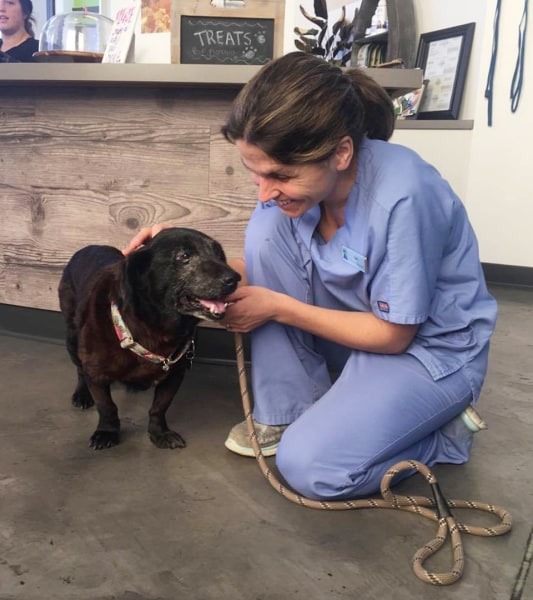
Dr. Beth Gordon is a veterinarian at High Valley Veterinary Hospital, in Ramona, California, who examined Blackie after her rescue. Gordon said Blackie has a heart murmur, some scars on her body, one wonky eye and teeth that have been neglected.
ackie, before her surgery, with veterinary technician Deborah Whitman | Courtesy of Frosted Faces Foundation
Then, of course, there is the tumor, which was big, infected and "very painful" for Blackie, Gordon said. "Someone didn't take very good care of her at all."

That's changed now. Blackie is at Frosted Faces Foundation headquarters, near San Diego.

She is being tended to — and with a lot of love.

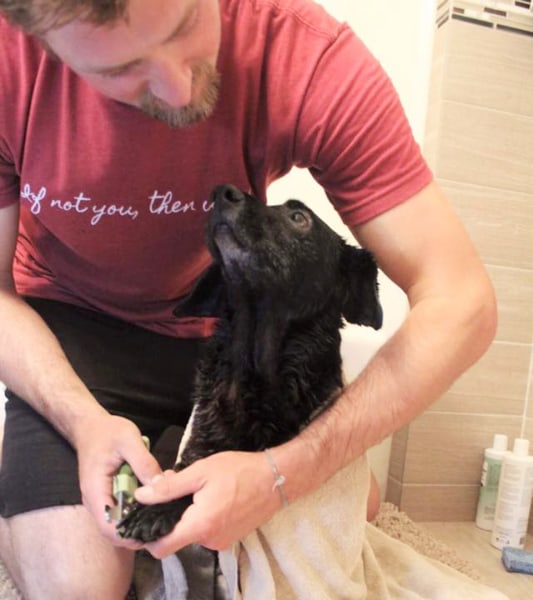
Blackie enjoys her spa treatment. | Courtesy of Frosted Faces Foundation
Blackie has quickly learned the pleasures of being clean, and of wearing a fresh new collar, eating plenty of good food and resting on soft beds.

Her teeth have been brushed, her nails trimmed and she rolls right over for belly rubs "if you give any indication of wanting to pet her," said Smíšek .
Blackie with Frosted Fraces Foundation volunteer Kelly Anne Honrath. | Courtesy of Frosted Faces Foundation
Blackie's had surgery to remove her tumor. And to be safe and make sure no cancer cells were left, most of her tail was also removed.

Biopsies showed that Blackie had been suffering from the sort of cancer that often spreads into a dog's lymph nodes and lungs.

"But diagnostics have proven that it had not yet," said Smíšek. "She has recovered well, the swelling has gone down and she is running around happily."
Blackie is all smiles now. | Courtesy of Frosted Faces Foundation
Soon, Blackie will be running around happily in a home.

Frosted Faces Foundation is sorting through the applications that have been placed by people who want to make sure that Blackie's next act is better than what came before.

Once her stitches come out, and she is medically cleared, Blackie will go to what's called a "forever foster" home. Frosted Faces covers these dogs' medical bills. The foster homes promise to love and care for the dogs for as much time as they've got left.

It's impossible to say how long that could be. Gordon believes Blackie could have another three or four years of life ahead.

SOURCE: Today

Pinky-Sized Marine Animal Breaks Record for Ocean Filtration

A small marine creature just broke the world record for ocean filtration and is a newly named champion in the fight against climate change.
Giant larvaceans, marine animals the size of a human pinky, are so fragile that nets destroy them. Scientists have therefore desired to study them in the wild, but only recently achieved the feat using a remotely operated vehicle that launched a high-tech laser and optics gadget, DeepPIV, which looks like something out of a James Bond film. Kakani Katija, who led the effort from aboard the surface vessel Rachel Carson in Monterey Bay, described what happened next.

“When we turned off the white lights and turned on the laser, there was a collective gasp in the room — we couldn’t believe what we were seeing,” said Katija, who is the principal engineer at the Monterey Bay Aquarium Research Institute.

“We could see the larvacean pumping its tail,” she continued. “We could see the interior chambers of the filters. We could see the motion of fluid in and through the house (the animal’s filtration system).”

It was then that her colleague, senior scientist Bruce Robison, shouted, “Wow! We’re pulling back the veil of ignorance.”

Doing so revealed that a giant larvacean known as blue-tailed Bathochordaeus filters particles out of water faster than any other marine creature. It beats the prior record holder, plankton called salps. The findings are reported in the journal Science Advances.
MBARI’s MiniROV with its DeepPIV system undergoing trials in a test tank. Bubbles in the water in front of the ROV are illuminated by a sheet of light from the laser at lower left. | Paul McGill/MBARI
Giant larvaceans, a type of zooplankton, are the key to the so-called biological pump. This is a process whereby organisms in the ocean transport carbon from the atmosphere into the deep sea, where some of that carbon is sequestered.

Capturing and sequestering carbon help to mitigate global climate change, so we and every other species on the planet benefit from the ocean filtration talents of these tiny creatures every day of our lives.

“We have estimated that as much as a quarter of the organic carbon transported to the deep bottom of Monterey Bay comes from discarded giant larvacean houses,” Robison said, adding that giant larvaceans are also located in oceans across the world.

He and Katija explained that giant larvaceans first make the rudimentary filtration “house” by excreting mucus from a series of cells located on its head.

“At some point in the build process, the larvacean starts moving its tail in a specific fashion, where we suspect the animal is forcing fluid through the house rudiment, and effectively blows up the rudiment like a balloon,” Katija said.

The house is then ready for action, filtering phytoplankton and other organic particles. These materials stick in the mucus house for digestion. When the filtration system fills up with waste matter, the entire nutrient-rich house is discarded and sinks to the sea floor. There, it provides a source of food for deep-sea animals. Giant larvaceans at that point may swim to another location, prior to building another house, in order to start the process all over again.

The animals have such an effective filtration system that researchers have even considered adding them to the ocean to do more good work. That idea was shut down quickly, however, due to concerns over unintended consequences, such as disruption of the marine ecosystem.

Robison said scientists of the past learned hard lessons about unintended consequences. He then listed some of the colossal failures: bringing mongooses to Hawaii to control rats in sugar cane fields (mongooses became an invasive species there); dumping radioactive waste in the ocean (causing pollution and hurting marine life); and bringing kudzu plants from Japan into the states to feed livestock (kudzu became an invasive species).

“The list goes on and on,” he added. “Upsetting the balance of nature can be a tricky business, especially when dealing with an ecosystem as poorly known as the deep sea.”

The researchers, however, hope to further study larvaceans. They also plan to use DeepPIV to obtain more accurate measurements of carbon removal by other deep-water organisms.

“Who knows what else is out there?” Robison asked. “The deep ocean is the least explored habitat on Earth, and we are only beginning to learn who is out there and how it all works.”

SOURCE: Seeker

Handstanding Skunks' DNA Shaped by Ancient Climate Change

Western spotted skunks — striped skunks' smaller cousins that stand on their "hands" to blast their smelly defensive spray — are helping scientists piece together a picture of how ancient climate change shaped animal populations millions of years ago, and could provide clues for how present climate change may affect animals alive today.
Image: skeeze-272447/Pixabay

These endearing and widely distributed skunks have been around for about 1 million years and live in a range of habitats across western North America. But even though the skunks all belong to one species, Spilogale gracilis, genetic differences divide them into three distinct groups that are known as clades, and scientists have puzzled over what might have driven these changes in the skunks' DNA.


Researchers investigating these adorable little stinkers recently discovered the likely scenario that led to these genetic divisions — ancient climate change during the Pleistocene ice age, as glaciers divided skunk populations into habitats isolated from each other.


Unlike the bold bands of white fur lining the black backs of striped skunks, western spotted skunks' markings curve and twine like the walls of a maze, with a single large spot marking the center of their heads. They are the smallest of the North American skunks, with males measuring about 16 inches (41 centimeters) in length and weighing about 22 ounces (630 grams), according to a species description by the Montana Natural Heritage Program and Montana Fish, Wildlife and Parks. 

Western spotted skunks perform "handstands" just before they spray. | Credit: Copyright Jerry W. Dragoo

Because their distribution is so broad — from British Columbia to northern Mexico, and from California to the central Great Plains — groups of skunks could potentially be separated from each other by many natural geographical barriers, such are rivers and mountain ranges. Scientists wanted to know whether geography could explain how skunk populations separated from each other and evolved unique genetic signatures, or if other land-shaping factors might have played a part, study lead author Adam Ferguson, collection manager of mammals at the Field Museum of Natural History, told Live Science.


"We were interested in whether we would see if genetic breaks are associated with older events — major biogeographic events, like the Sierra, the Rockies, the Rio Grande — or with climate change," Ferguson explained.


Stinky study subjects

In general, skunks aren't well-studied, probably because working with them comes with an odious olfactory price — "even their tissues stink," Ferguson said. In fact, during each season of fieldwork, he puts aside what will be "the skunk clothes," an outfit that sometimes must be permanently retired when the season ends, he said.


Study lead author Adam Fergusun wearing impromptu Kleenex nose plugs — not to block the smell of his study subject, but because he had a cold. | Credit: Courtesy of Adam Fergusun

For the study, the scientists sampled genetic data from 97 skunks representing a range of habitats and climates in the southwestern U.S. But the genetic differences that separated them didn't map to geographic features. For example, two skunk populations divided by mountains were mostly identical on a genetic level, the study authors found.


By modeling climate conditions during the ice age glacial maximum — the period when ice covered the most land mass — the researchers discovered that advancing glaciers could have effectively isolated habitat "refuges" from each other, allowing genetic differences to evolve in separated animal groups.


Their findings help to fill in the picture of how ancient climate change affected not only the western spotted skunks, but possibly other animals as well — large and small — that shared the skunks' habitats across the southwestern U.S. And this could help scientists predict how ecosystems and their inhabitants might be affected by present-day climate change, Ferguson said.


"If we have data from rodents, bats, small carnivores, large carnivores, reptiles, birds, we can say, 'How as a whole would the Sonoran Desert community respond potentially to climate change across the board?' You can make these general predictions of how climate change might affect an entire community — not just a single species," he told Live Science.


The findings were published online today (May 3) in the journal Ecology and Evolution.


SOURCE: LiveScience

Wednesday, May 3, 2017

Humpback Whales Are Dying in Increasing Numbers Off the Atlantic Coast

Some 41 humpback whales have been found dead in the waters off Maine to North Carolina, where many appear to have been killed by colliding with boats.
Investigators are probing an unusually high number of humpback whale deaths since 2016 off the US Atlantic Coast, where many appear to have been killed by colliding with boats, officials said Thursday.

A total of 41 humpback whales (Megaptera novaeangliae) have died in the waters off Maine to North Carolina, said the National Oceanic and Atmospheric Administration.

Twenty-six died last year, far higher than the average annual number of humpback whales for the area — just 14.

So far this year, 15 have already washed up dead.

“The increased numbers of mortalities have triggered the declaration of an unusual mortality event, or UME, for humpback whales along the Atlantic Coast,” said Mendy Garron, stranding coordinator at the NOAA Fisheries Greater Atlantic Region.

A UME is issued whenever a stranding is “unexpected, involves a significant die-off of any marine mammal population, and demands immediate response,” she told reporters.

Animal autopsies — known as necropsies — have been performed on 20 whales.

Ten of the marine mammals showed acute signs of blunt force trauma or large propeller cuts from colliding with ships or boats, suggesting that this was the likely cause of death.

The other 10 had no such obvious signs, and researchers are continuing tests to find out what other factors could have contributed to their demise.

Cause unknown

“Whales tested to date have had no evidence of infectious disease,” said Garron.

Researchers stressed they have yet to uncover the cause of the unusual spike in deaths.

“The answer is really unknown,” said Greg Silber, coordinator of recovery activities for large whales with the NOAA Fisheries Office of Protected Resources.
There is no known spike in vessel traffic in the area, but humpback whales move around in search of prey, which could bring them closer to shore, he added.

Humpback whales grow to between 48 and 62 feet (15-19 meters), weigh 40 tons, and are known for their haunting songs that travel great distances underwater.

Most humpback whales are no longer considered an endangered species, after that designation was lifted in 2016 due to a rebounding population.

There are more than 10,000 humpback whales in the North Atlantic Ocean.

But there are 14 distinct populations of the whales, five of which are still endangered, including those in the Arabian Sea, Cape Verde Islands, northwestern Africa, the Western North Pacific and Central America.

An international moratorium on hunting them was established in 1982 and remains in place.

Unusual die-offs of humpback whales in the Atlantic Ocean were also reported in 2003, 2005, and 2006, NOAA said. The cause of those deaths were undetermined.
SOURCE: Seeker

Seals Are Being Left Temporarily DEAF from the Noise of Sea Traffic in Britain's Busiest Shipping Lanes

Seals are being temporarily deafened by underwater noise in the UK's busy shipping lanes, a new study suggests.
Noise in the shipping lanes is causing some seals to suffer from temporary deafness
Researchers compared the experience of the seals to that of people living amidst the din of inner cities.

Ecologist Dr Esther Jones, from the University of St Andrews , said: “Like humans living in busy, noisy cities, some seals live in areas where there is a lot of shipping traffic and associated noise.

“The UK has some of the busiest shipping lanes in the world, and underwater noise has been increasing over the last 30 years.”
Container ship at Southampton Port
Ships are being blamed for causing a din for seals underwater (Photo: PA)
Her team drew up maps showing the extent to which grey and harbour seals around the UK were affected by shipping traffic.

The scientists then investigated noise levels individual animals were likely to be subjected to in Moray Firth on the north-east coast of Scotland.

For 20 of the 28 seals studied, the predicted noise was loud enough to cause temporary hearing loss.

The maps showed that 11 of 25 Special Areas of Conservation (SACs) may contain seals affected by shipping.
Scientists have compared the racket to like living in an inner city (Photo: Scott Barbour/Getty Images)
Dr Jones added: “Urbanisation of the marine environment is inevitably going to continue, so chronic ocean noise should be incorporated explicitly into marine spatial planning and management plans for existing marine protected areas.

“We now need to begin assessing any behavioural changes of seals as a result of chronic exposure to underwater noise, so that we can understand the implications of those changes on individuals and ultimately on population dynamics.”

The scientists, whose findings appear in the Journal Of Applied Ecology, now plan to tag seals with sound and movement recording devices to investigate how their behaviour is affected by noise.

SOURCE: Mirror.co.uk

The Fossil of a Half-Billion-Year-Old, 50-Legged Arthropod Was Found in Canada

The 4-inch-long creature, named Tokummia katalepsis, was discovered in sedimentary rock in Kootenay National Park in British Columbia.

A 508-million-year-old critter — one that looks like a weird lobster with 50 legs, two claws and a tent-like shell — is the oldest known arthropod with mandibles on record, a new study finds.

Arthropods are a group of invertebrates that includes spiders, insects and crustaceans. Many arthropods, including flies, ants, crayfish and centipedes, have mandibles — appendages that can grasp, crush and cut food. But until now, it wasn't clear when this unique feature evolved.

Now, researchers can say that mandibles developed by at least the late Cambrian (the Cambrian period, known for its famous explosion of new, diverse life, lasted from about 543 million to 490 million years ago).

Researchers discovered the first of the 21 fossil specimens in sedimentary rock in Kootenay National Park, in British Columbia, Canada, in 2012. They named the roughly 4-inch-long (10 centimeters) creature Tokummia katalepsis, honoring Tokumm Creek, which runs along the northern part of the park through Marble Canyon, where they found the fossils. The species name, katalepsis, is derived from the Greek word for "seizing."

Like other Cambrian animals, T. katalepsis looks bizarre by today's standards. The predator had 50 paddle-like legs that likely helped it swim and walk in a tropical sea, and "a pair of very strong claws — some of the strongest claws we have seen in any Cambrian arthropod," said study co-author Jean-Bernard Caron, a senior curator of invertebrate paleontology at the Royal Ontario Museum in Canada. These claws likely helped the animal grasp and pierce soft-bodied prey, such as worms, he said.

The critter also had a bivalve (two-halved) shell and two tiny eyes at the base of its antennae. But T. katalepsis' most famous features are its serrated mandibles, Caron said.

Mandible evolution

The group mandibulata (animals with mandibles) is the most diverse and abundant group of arthropods on the planet. The group includes the myriapods (millipedes, centipedes and their relatives), the pancrustaceans (including shrimps, lobsters and barnacles) and insects, said study lead researcher Cédric Aria, who did the research while a doctoral student of ecology and evolutionary biology at the University of Toronto. Aria is now a postdoctoral researcher at the Nanjing Institute for Geology and Paleontology in Nanjing, China.

Initially, some researchers thought these bivalved species were among the earliest ancestral arthropods, Aria said. But the new analysis shows that instead of being at the base of the arthropod family tree, T. katalepsis evolved later on, after the chelicerata (spiders and mites) split off into their own branch.

"Quite simply, Tokummia (and its relatives) fits at the base of all mandibulates," Aria told Live Science in an email.
Cédric Aria cutting into the fossiliferous beds at Marble Canyon quarry at Kootenay National Park during the summer 2014 fieldwork season. | Jean-Bernard Caron/Royal Ontario Museum
In addition, an analysis of T. katalepsis' anatomy revealed what other characteristics made mandibulates so successful. For instance, its more than 50 body segments were an important adaptation for mandibulates, "as it allowed for the development of additional segments and structures at and around the base of the limb, called 'coxae,' and from which the mandibles themselves likely [arose]," Aria said.

The new finding is only the latest fossil discovery from Marble Canyon. Other Cambrian fossil discoveries there include an ancient fish known as Metaspriggina and a four-eyed arthropod called Yawunik.

Outside perspective

The finding is a potential novel perspective on the evolution of arthropods, said Jakob Vinther, a paleobiologist at the University of Bristol in England, who was not involved with the study. However, he cautioned that because the fossils are flattened, they might be difficult to decipher.

"Finding mandibles is a key finding for understanding the evolution of myriapods, crustaceans and insects," Vinther said. "I hope that the observations can be validated by other researchers also in the near future."

However, another paleobiologist, Peter Van Roy at Ghent University in Belgium, who was also not involved with the study, called the study and interpretation of the material "well-supported from what I can see."

Van Roy added that "these fossils elucidate the early evolution of this very important clade [group], which so far was poorly understood, and underscore the importance of exceptionally preserved fossils for resolving phylogenetic [family tree] questions in deep time."

The study was published online today (April 26) in the journal Nature.

SOURCE: Seeker

Tuesday, May 2, 2017

Last Remaining Male Rhino Goes on Tinder to Highlight Crisis

Sudan, aged 41, 6ft tall and 5,000lbs, is described as "the most eligible bachelor in the world".
The last surviving male northern white rhino, called Sudan
A rare northern white rhino has gone onto the Tinder dating app in an attempt to keep his species alive.

Sudan, the world's last surviving male animal of his kind, is described as loving the outdoors and enjoying travel.

His listing says: "I don't mean to be too forward, but the fate of my species literally depends on me.

"I perform well under pressure. I like to eat grass and chill in the mud. No problems. 6ft tall and 5,000 pounds if it matters."

His owner, the Ol Pejeta conservation refuge in Kenya, hopes to raise awareness of the precarious position the species is in.
Sudan's page on the dating app Tinder
But it also hopes to raise cash for an artificial insemination programme that may allow Sudan to have the children he has so far been unable to.

The $9m they need would pay to get Sudan's sperm to fertilise eggs provided by the two last surviving female white rhinos, either 17-year-old Satu or 27-year-old Najin.

If Sudan's sperm cannot be used, they will use stored semen from another dead animal.
The resulting embryo would then be implanted in a surrogate southern white rhino, a much more common species.
A northern white rhino called Sudan
Sudan is 43, which is ancient for a white rhino
Sudan is 43, which is ancient for a white rhino, and keepers fear he may die or be killed before he can find a mate.

He is in such danger because white rhino horn costs up to £50,000 a kilo - something that has led the species to the brink of extinction.

Just hours after Sudan went online, the webpage crashed due to the number of hits.

SOURCE: News.sky.com

Monday, May 1, 2017

Wild Deer Visits 81-Year-Old Woman Twice A Day For A Snack

Experts typically say you shouldn’t feed wild deer. But in this case, it’s saved the stag from hunters.
Having a friend who mooches off you twice a day is usually annoying, but 81-year-old Mette Kvam doesn’t seem to mind.

Kvam lives alone in Aurland, Norway, and her friend is a wild deer named “Flippen.” He shows up at her doorstep twice a day looking for some grub, according to Inside Edition.

Flippen has been a daily visitor for the past three years and it’s not a one-sided friendship. In return for the goodies, he lets Kvam rub his head a little.

The friendship began in 2014, when Kvam saw the stag in her yard and offered him a cookie, according to the Good News Network. To her surprise, he cautiously accepted the snack.

Now he shows up for more food each day and family friend Britt Haugsevje Vangen couldn’t be happier.

“She says that they are so lucky for having each other,” Vangen told Caters News. “Mette has no kids and since her husband passed away she has no one ― she only has Flippen in her life now.”
Typically, wildlife experts advise people not to feed wild deer. Some human foods, like corn, can be disastrous for deer, with the wrong foods leading to serious disease and even death. It can also lead to them becoming dependent on humans for food.

However, in this case, the friendship appears to have paid off for Flippen. Local hunters who are aware of the friendship have made a point not to shoot the stag, according to Vangen.

SOURCE: Huffingtonpost

How Long Do Elephants Take to Poop? Same Time As You

The ancient Chinese practiced copromancy, the diagnosis of health based on the shape, size and texture of feces. So did the Egyptians, the Greeks and nearly every ancient culture. Even today, your doctor may ask when you last had a bowel movement and to describe it in exquisite detail.
A study of the physics of poop explains why it takes the same amount of time for you and an elephant to poop. | Credit: Claude Huot/Shutterstock
Sure, it's uncomfortable to talk about. But that's where science comes in, because what we don't like to discuss can still cause harm. Irritable bowel syndrome, inflammatory bowel disease, gastrointestinal infections and other poop-related ailments cost Americans billions of dollars annually.

But trying to stem these problems was not our main motivation for trying to figure out some of the physics of defecation. It was something else, much more sinister.

From personal observation, into the lab

When parenthood hits, it hits hard. One of us is a working dad who survived by learning a new set of skills, one of which was fecal analysis. Years of diaper changes and then potty training turned me from a poo-analysis novice to a wizened connoisseur. My life passes by in a series of images: hard feces pellets like peas to long feces like a smooth snake to a puddle of brown water.

Unlike the ancients, we didn't believe that we could predict the future from children's stool. But we did think it was worth trying to understand where all these shapes come from. Having a laboratory to answer questions about the everyday world is one of the distinct pleasures of being a scientist.

As fluid dynamicists, we joined forces with colorectal surgeon Daniel Chu, and two stalwart undergraduates, Candice Kaminski and Morgan LaMarca, who filmed defecation and hand-picked feces from 34 mammalian species at Zoo Atlanta in order to measure their density and viscosity.

We learned that most elephants and other herbivores create "floaters" while most tigers and other carnivores create "sinkers." Inadvertently, we also ranked feces from most to least smelly, starting with tiger and rhino and going all the way to panda. The zoo's variety of animals provided us with a range of fecal sizes and shapes that served as independent pieces of evidence to validate our mathematical model of the duration of defecation.

We also placed the feces in a device called a "rheometer," a precision blender that can measure the properties of liquid-like and solid-like materials such as chocolate and shampoo. Our lab shares two rheometers with Georgia Tech physicist Alberto Fernandez-Nieves. We have since categorized the rheometers as the "clean rheometer" and the "David Hu rheometer" – which has seen its fair share of frog saliva, mucus and feces.

The secret to the speed

What else did we learn? Bigger animals have longer feces. And bigger animals also defecate at higher speed. For instance, an elephant defecates at a speed of six centimeters per second, nearly six times as fast as a dog. The speed of defecation for humans is in between: two centimeters per second.

Together, this meant that defecation duration is constant across many animal species – around 12 seconds (plus or minus 7 seconds) – even though the volume varies greatly. Assuming a bell curve distribution, 66 percent of animals take between 5 and 19 seconds to defecate. It's a surprisingly small range, given that elephant feces have a volume of 20 liters, nearly a thousand times more than a dog's, at 10 milliliters. How can big animals defecate at such high speed?

The answer, we found, was in the properties of an ultra-thin layer of mucus lining the walls of the large intestine. The mucus layer is as thin as human hair, so thin that we could measure it only by weighing feces as the mucus evaporated. Despite being thin, the mucus is very slippery, more than 100 times less viscous than feces.

During defecation, feces moves like a solid plug. Therefore, in ideal conditions, the combined length and diameter of feces is simply determined by the shape of one's rectum and large intestine. One of the big findings of our study was that feces extend halfway up the length of the colon from the rectum.

A unified theory of pooping

Putting the length of feces together with the properties of mucus, we now have a cohesive physics story for how defecation happens. Bigger animals have longer feces, but also thicker mucus, enabling them to achieve high speeds with the same pressure. Without this mucus layer, defecation might not be possible. Alterations in mucus can contribute to several ailments, including chronic constipation and even infections by bacteria such as C. difficile in the gastrointestinal tract.

Beyond simply following our scientific curiosity, our measurements of feces have also had some practical applications. Our defecation data helped us design an adult diaper for astronauts. Astronauts want to stay in space suits for seven days, but are limited by their diapers. Taking advantage of the viscosity of feces, we designed a diaper that segregates the feces away from direct contact with skin. It was a semifinalist in the NASA Space Poop Challenge earlier this year.

It just shows that physics and mathematics can be used everywhere, even in your toilet bowl.

David Hu, Associate Professor of Mechanical Engineering and Biology, Adjunct Associate Professor of Physics, Georgia Institute of Technology and Patricia Yang, Ph.D. Student in Mechanical Engineering, Georgia Institute of Technology

This article was originally published on The Conversation. Read the original article.

SOURCE: Livescience

Sunday, April 30, 2017

10 of the World's Smallest Animals

1. World’s Smallest Dog: 12.4 cm (4.9-inch) tall
At 1.4 pounds and 4.9 inches tall, Ducky, a yappy short-coat Chihuahua from Charlton (Massachusetts, USA), holds the Guinness World Record for the world's smallest living dog (by height). Ducky succeeds Danka Kordak of Slovakia, a Chihuahua who measured 5.4 inches tall. The smallest dog ever, according to Guinness, was a dwarf Yorkshire terrier who stood 2.8 inches tall.

2. World's Smallest Snake: 10.1 cm (4-inch) long
Leptotyphlops carlae is the world's smallest species of snake, with adults averaging just under four inches in length. Found on the Caribbean island of Barbados, the species --which is as thin as a spaghetti noodle and small enough to rest comfortably on a U.S. quarter-- was discovered by Blair Hedges.

3. World’s Smallest Fish: 7.9 mm (0.3-inch) long
On January 2006, the world's smallest fish was discovered on the Indonesian island of Sumatra: a member of the carp family of fish, the Paedocypris progenetica. It is the world's smallest vertebrate or backboned animal; only 7.9 mm (0.3 inches) long. 

The title, however, is contested by 6.2 mm (0.2 in) long male anglerfish Photocorynus spiniceps (not technically a fish but a sexual parasite) and the 7 mm (0.27 in) long male stout infantfish Schindleria brevipinguis. 

4. World’s Smallest Horse: 43.18 cm (17-inch) tall
The little horse was born to Paul and Kay Goessling, who specialize in breeding miniature horses, but even for the breed Thumbelina is particularly small: she is thought to be a dwarf-version of the breed. At just 60 lb and 17-inch tall, the five-year-old Thumbelina is the world’s smallest horse. 

5. World’s Smallest Cat: 15.5 cm (6.1-inch) high and 49 cm (19.2-inch) long
Meet Mr. Peebles. He lives in central Illinois, is two years old, weighs about three pounds and is the world's smallest cat! The cat's small stature was verified by the Guinness Book of World Records on 2004. 

6. World's Smallest Hamster: 2.5 cm (0.9-inch) tall
Only slightly bigger than a 50p piece, PeeWee is the smallest hamster in the world. Weighing less than an ounce, the golden hamster stopped growing when he was three weeks old - his five brothers and sisters went on to measure between 4in and 5in. 

7. World's Smallest Chameleon: 1.2 cm (0.5-inch) long
The Brookesia Minima is the world's smallest species of chameleon. This one is just half an inch. Found on the rainforest floor of Nosy Be Island off the north-west coast of Madagascar, females tend to be larger than males.

8. World's Smallest Lizard: 16 mm (0.6-inch) long
So small it can curl up on a dime or stretch out on a quarter, a typical adult of the species, whose scientific name is Sphaerodactylus ariasae is only about 16 millimeters long, or about three quarters of an inch, from the tip of the snout to the base of the tail. It shares the title of "smallest" with another lizard species named Sphaerodactylus parthenopion, discovered in 1965 in the British Virgin Islands. 

9. World’s Smallest Cattle: 81 cm (31-inch) height
The world’s smallest cattle is a rare breed of an Indian zebu called the Vechur cow. The average height of this breed of cattle is 31 to 35 inches (81 to 91 cm). The photo above shows a 16 year old Vechur cattle as compared to a 6 year old HF cross-breed cow. 

10. World's Smallest Seahorse: 16 mm (0.6-inch) long
The creature, known as Hippocampus denise, is typically just 16 millimetres long - smaller than most fingernails. Some were found to be just 13 mm long. H. denise lives in the tropical waters of the western Pacific Ocean, between 13 and 90 metres beneath the surface. 

SOURCE: Oddee

Think Twice Before Flying with Your Pet. Here’s Why.

Thinking about taking Fido, Fluffy or any four-legged friend with you on a plane? Don't book a ticket before reading this!
JAROMIR CHALABALA/SHUTTERSTOCK
You might still be wiping away the tears after hearing about the 3-foot-long, 10-month old bunny that passed away in cargo, while waiting for a connecting United Airlines flight in Chicago. Even if you opt for a pup or a kitty instead of an over-sized bunny rabbit, any pet owner can relate to the sheer terrifying thought that your precious furry companion could perish while traveling.

The cause of this bunny’s tragic end is still unknown, but travel agent, Greg Antonelle explains the threat: “There are a variety of theories on what may cause a pet to die while in cargo on a plane, but certainly the extreme temperatures, fluctuation in air pressure, and excessive noise would seem to play a part,” he says.

Though very sad for all involved, it is rare that pets pass away on planes. In 2014, for example, there were only 17 reported pet deaths, according to the U.S. Department of Transportation. However, before you decide to pack up Lucky or Snowball for a trip cross-country, there are some things to keep in mind when packing up a pet:

Cargo or Carry-On?
What part of the plane your pet travels on depends largely on their size and weight. As Antonelle explains, if your cat or dog can fit underneath the seat in front of you, then they can count as your carry-on and be by your side from takeoff to landing. (Check with your airline regarding exact weight restrictions.) However, larger pets, like bigger dogs, or say, a huge bunny, are put in cages or crates in cargo, where checked luggage is stored. It’s also important to note that there’s always a fee associated with bringing a pet with you, which varies by airline, with a rough estimate of $150 each way. The only exception to the rule? 

If You Have a Service Animal…
“Over the last couple of years, there has been an increasing number of passengers who have requested to take their ’emotional support’ animals in the cabin with them. (To receive the ‘doctor’s note’ out of cargo, animals must be trained as an emotional support pet, gaining a certificate that could be required upon check-in.) These pets have ranged from dogs to cats to pigs to little primates, Antonelle says. Being in the cabin with you calms not only your nerves, it also calms your pets. “Being in the cabin with its owner allows the pet a bit more security and eases some of the nerves of the pet compared to being stored in cargo.” (Psst: if you try and get one of these bad boys off the Internet, it’s important to note that if you’re caught and prosecuted, it’s considered a felony offense in the United States.)

Certain Pets Shouldn’t Fly
Have a bulldog, a pug, or another snub-nosed pup? Or a Himalayan cat? Antonelle says it’s not recommended to bring these onboard, due to their medical history and risks. “These breeds should not fly on planes due to their known propensity for respiratory issues. Many airlines now restrict these animals from flights,” he notes. And, it goes without saying, that if your pet is older or has health issues, chances are, its better off at home.

Bottom Line: Leave Them At Home
Unless you absolutely have to travel with your pet, say for a long visit to grandma’s and you don’t want to board them, Antonelle says it’s better for the animal to stay put. “If your only choice is to put the pet on the plane, then fine, but if you’re merely going on vacation and want your pet with you, it’s probably best to have a friend or family member watch the pet and not have to worry about it surviving a flight,” he says. “If you must take your pet on a flight, it is recommended to book a direct flight. The minimal amount of time the pet is in the cabin or cargo area reduces any risk of death or injury. Likewise, it’s always recommended to have your pet examined by your vet so they can ensure that the pet is fit to fly.”

SOURCE: RD

Friday, April 28, 2017

Adorable Bat Can't Resist Sticking His Tongue out for the Camera After Taking a Cool Dip

Thousands of Indian Flying Fox bats have moved to the edge of the Upper Lake in Bhopal, India, as temperatures soar past 45C.
This is the moment a cheeky bat stuck his tongue out for the camera (Photo: Devendra Dube / SWNS)

This is the moment a cheeky bat stuck his tongue out for the camera after a cool dip in a lake to escape India's searing summer.

Thousands of Indian Flying Fox bats have moved to the edge of the Upper Lake in Bhopal, India, as temperatures soar past 45C.

A few times a day the fruit bats swoop from the branches of the surrounding trees and belly flop into the water to cool down before 'hanging up to dry'.

Bats are warm blooded mammals and - like humans - face death from dehydration if temperatures rise over 45 degrees.
One of Devendra Dube's pictures of bats in Bhopal (Photo: Devendra Dube / SWNS)

A bat takes a cool dip in Bhopal (Photo: Devendra Dube / SWNS)
Thousands of bats are trying to escape the heat (Photo: Devendra Dube / SWNS)
Having a quick dip and then fanning their wings out wide helps them battle extreme heat stroke that kills off thousands of bats elsewhere in the country.

Fruit bats have very long tongues that unroll when they are feeding, and are tucked away internally around the rib cage when not in use.

Photographer Devendra Dube witnessed the amazing scenes earlier this week.

He said: "If the temperature is more then 45 degrees the bats fall down from trees and die in large numbers - this happened last year.
Bats in Bhopal (Photo: Devendra Dube / SWNS)
"These bats lives near Upper Lake and they take a dip in water and get wet and hang back on trees.

"They do this many times a day to stay cool.

"At the end of the Summer these bats migrates to the jungle near Bhopal and come back after rain."

SOURCE: Mirror.co.uk
 
Copyright © 2017 Online Weird Stories: Weird Stories Worldwide. Designed by OddThemes